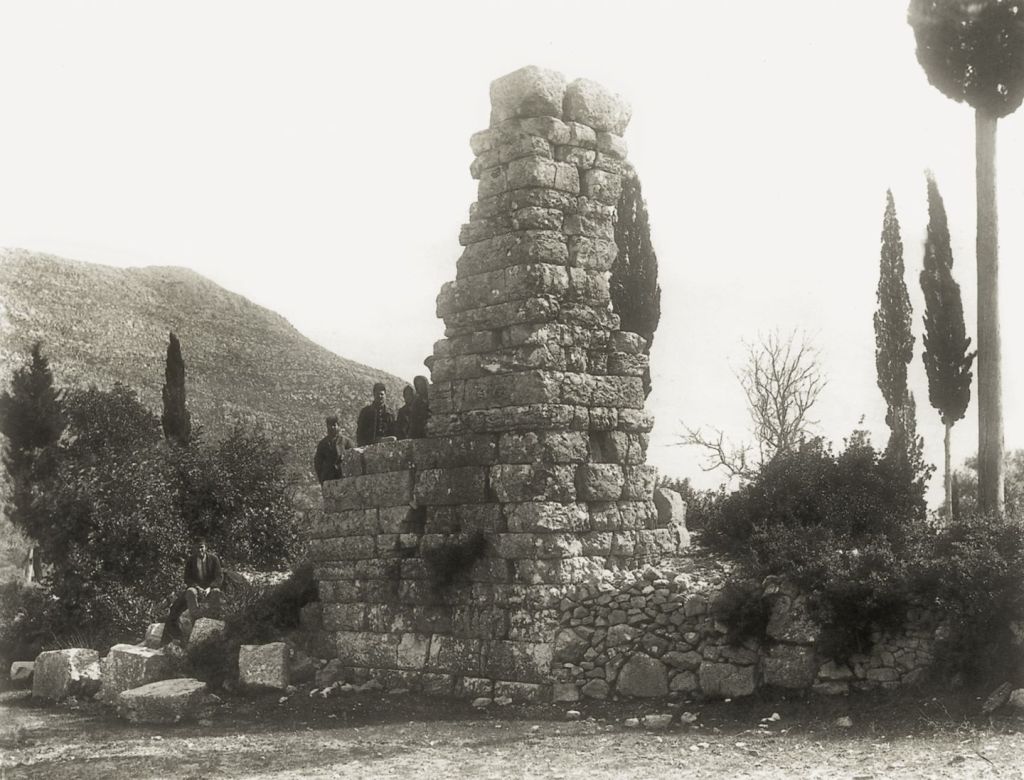
Hidden in olive groves, on terraces and on high mountain plains, Lefkada has the remains of at least nineteen ancient stone towers at fifteen sites, most built between the late 5th and the 3rd centuries BC. Nobody knows for certain what they were for. Some look like fortified farmhouses. Others stand on headlands and terraces with commanding views over the sea channels and plains, as if keeping watch. They may have been both.
Few visitors, and not many islanders, know they are there. Several stand right beside our walks. This page sets out what is known, what is still argued over, and where to find them.
Map
Towers whose position we have; click a marker to jump to its description. Positions are approximate: please let us know if you find one is wrong.
What were they?
The towers come in three kinds. The earliest were round, about 5–6 m across, with a stone base carrying walls of mud brick. Later came square towers about 7 m a side, with a base of fitted many-sided (polygonal) blocks, again probably topped with mud brick. A few were built entirely of cut stone. At Poros, and at Achuria on Nidri Bay, a square tower replaced an earlier round one, suggesting the round towers came first, in the Classical period, and the square ones in the 4th and 3rd centuries BC.
What they were for is still an open question. The case for farms is strong. Many stand on the island’s most fertile land – the Nidri plain, the plains around Marantochori and the high plain above Eglouvi – often well away from any ancient town, and around some are enclosure walls, cisterns, storerooms and presses. Dörpfeld, who first recorded them, thought they were tower-houses, and the archaeologist Sarah Morris, who surveyed them in 1991–92, agrees: fortified homes where an extended family and its workers grew and processed olives and grapes, with a tower to keep people, harvest and tools safe in a dangerous age. Their spread may go with a boom in wine-growing; Leucadian wine was praised in antiquity.
But their positions are hard to ignore. Many stand at strategic spots rather than in the middle of the fields: Helleniko on its terrace commanding the Nidri plain; Hellenika at the tip of the Kastri peninsula, looking over the channel and in sight of Cape Lefkatas; Kroupa on its knoll opposite Nidri; and a round tower on a shelf above the shore between Lefkada Town and Nidri, at a natural landing place from the mainland. Morris herself writes that some seem placed “as if to support a defensive zone” along the channel. Thucydides records that during the Peloponnesian War fire signals from Leucas warned Corcyra at night that sixty Athenian ships were coming (3.80), though a beacon on a peak may have been enough for that. Poros, by contrast, is tucked away out of sight of the sea. Perhaps they were farms, refuges and lookouts at once, or different towers served different needs. The towers keep their secret.
Discovery
Wilhelm Dörpfeld, digging on Lefkada between 1901 and 1913 in search of Homer’s Ithaca (see Homer’s Ithaca), recorded seven of the towers and photographed several. In 1991–92 a team from UCLA and Tulane University led by Sarah Morris and Jane Carter cleared, measured and drew fifteen tower sites, with help from local people who knew where the stones were. Their report, published in 2001, is the source for this page. Some towers Dörpfeld saw have since disappeared under new building, and others are surely still waiting to be found.
Poros (Pyrgi) – the best preserved
Just above the village of Poros, about half a kilometre south of the chapel of Agios Nikolaos, the square tower at the place called Pyrgi still stands over 7 m high – twenty-two courses of cut stone at one corner. It has stood through the earthquakes of 1915 and 1948. Beside it is a walled complex with the remains of a press, built around an earlier round tower. The site is tucked into a valley out of sight of the sea, chosen for its farmland, not as a lookout, and was lived in for about three centuries. Until the 1950s, some thirty Poros families still moved up to Pyrgi each summer with their animals.
Walk: right beside the Dessimi to Poros Cape Loop.
Around Nidri
The fertile Nidri plain, settled since the Bronze Age, has the densest cluster of towers.
Palaiokatouna
Below the village of Palaiokatouna, among old olive groves, lie the foundations of the largest tower on the island, about 9.7 by 8.7 m. Its huge blocks were held together with iron clamps, and its inner cross-walls are the best preserved of any tower on Lefkada. Dörpfeld excavated it in 1901. Walk: about 400 m from the Nidri – Dimosari Waterfall – Neochori Loop.
Mavroneri, above Neochori
Past the village of Neochori, on the hill below the chapel of Agios Vlassis at about 350 m, are the foundations of a cut-stone tower about 6.3 m square, above the gorge of the Mavroneri stream and its abandoned watermill. Walk: right beside the Vafkeri Lower Loop.
Helleniko, on the slopes of Skaros
On a natural terrace at about 85 m, with a commanding view over the Nidri plain, stands the polygonal base of the tower locals call Helleniko, three to four courses high. Terrace walls and rock-cut steps nearby suggest a whole settlement on this hillside. Walk: about 150 m from the Nidri – Dimosari Waterfall – Neochori Loop.
Lost and hidden towers
Below the village of Katochori, above the Dimosari stream, are the remains of a tower about 8.2 by 8.6 m. At Achuria on the east side of Vlicho Bay, Dörpfeld photographed a square tower built over an earlier round one; it now lies buried under holiday homes. A second tower he marked on the western Nidri plain could not be found in 1991.
Eglouvi and its high plain
At 880 m, the plain west of Agios Donatos is one of the most productive on the island, sown with wheat and lentils in alternate years and dotted with old stone huts for storing grain. On its southern edge, near a rock outcrop called Lithanofli (like the taverna in the village), stands a nearly square tower, about 8.4 m a side, with a polygonal base and a massive threshold stone over 2 m long still lying by its doorway on the south side. A second tower lies north-west of Eglouvi, just east of a rock ridge with a niche dedicated to Agios Philippos.
Walks: both are close to the Eglouvi to Agios Donatos and the Lentil Fields Loop and the Thousand-Metre Peaks Challenge. See also Eglouvi.
Marantochori and the south
The plains around Marantochori, some of which flood in winter, held three tower sites. At Sta Marmara, south of the village, two square towers stand 30 m apart on terraces above the plain, with a plastered cistern between them. Across the valley is the Choirospilia (“pig cave”), which led Dörpfeld to place Homer’s swineherd Eumaeus here. At Kleismatia, north of the village, a square and a round tower stand among olive groves. At Sto Pyrgo, below the church of Agios Georgios north-west of the village, a ring of bedrock over 9 m across marks a round tower whose stones were taken to build the cemetery wall above.
Further south, at Hellenika near the tip of the Kastri peninsula south-east of Vasiliki, standing polygonal walls of a square tower and enclosure look out over the channel to Cape Lefkatas.
On the east coast
At Kroupa, a rocky knoll on the Geni peninsula opposite Nidri, a ring of cut stone 6.4 m across is all that remains of a round tower with Classical pottery around it – perhaps a guide for ships entering Nidri harbour. At Magemeno, on the coast near Nikiana, a round tower had its own cistern cut into the rock and lined with pink plaster.
More are reported: walls at Syvros, a round tower near the sea in the Vasiliki plain, and a tower above Perigiali at the east end of Skaros. If you know of others, tell us in our Facebook group.
Visiting
Apart from Poros, most towers are low foundations, often overgrown and easy to miss. They stand on private farmland: keep to paths and tracks, close gates, and don’t cross sown fields. They are protected antiquities, so please don’t climb on them or move any stones.
Sources
- Sarah P. Morris, “The Towers of Ancient Leukas: Results of a Topographic Survey, 1991–1992”, Hesperia 70 (2001), pp. 285–347.
- Wilhelm Dörpfeld, Alt-Ithaka (Munich 1927). His photographs of the towers are in the archive of the German Archaeological Institute (DAI) in Athens.