Religion runs deep on Lefkada. For most of the last five hundred years its monasteries were far more than places of prayer. They were among the island’s biggest landowners and employers, keepers of books and icons, and the heart of village life on their feast days. When Ottoman rule ended in 1684 there were eighteen working monasteries and many smaller dependencies, from the Gyra sandspit by Lefkada Town to Ira near the southern tip, and across the water on Meganisi.
Many of them stand on or close to our walks. A few are still home to monks or nuns, some are being restored, and many are quiet ruins in the forest. This page tells their story and takes you to each one.
Much of what follows comes from a talk given in Alexandros in 2014 by Archimandrite Ioannikios Zambelis, drawing on Ottoman court records, Venetian decrees and the monasteries’ own archives (see Sources). Where a story is Church tradition rather than documented history, we say so.
A short history
By Church tradition, Christianity came to Lefkada early: five Holy Fathers reached the island in 325, and three of them settled in a cave on Skaros (see Early Christianity on our History page).
Few documents survive from the Byzantine centuries, but buildings do. The ruined church of Agios Nikolaos at Nikoli, with its brick-banded walls and rounded apse, dates from the 10th century, and a monastery of the Odigitria near Lefkada Town is recorded in 1025. In the 15th century, when the Italian Tocco family ruled the island, the Odigitria church was rebuilt (1449/50).
Perhaps surprisingly, the monasteries flourished under Ottoman rule (1479–1684). Ottoman court records show the Red Church buying fields in Alexandros from a Muslim landowner in 1626, being given vineyards at Fryni in 1648, and taking over two ruined monasteries in 1666. In 1716 the island’s monks petitioned the sultan together against unfair extra taxes.
In 1689, soon after Venice took the island, the archbishop moved his seat from the Episkopi monastery into Lefkada Town. Venetian decrees of 1701 and 1754 put the monasteries’ affairs and their trustees under state control.
The heaviest blows came later. In 1804 the Septinsular Republic closed every monastery on the island except St George’s on Skaros and Faneromeni, and moved the monks into those two; a decree of 1810 restored them. After union with Greece in 1864 the privately owned monasteries were abolished. Between 1926 and 1932 most of the monasteries’ land was expropriated and the monasteries merged, ending a landholding system that had lasted more than five centuries. The aim was to give land to families who had none, and some did benefit, though in the villages it is remembered that much of the better land went to those with good connections. It took away work as well as land, and for villages like Alexandros it was part of their decline (see St George’s). In 1968 the remaining monasteries were dissolved and their property passed to the Church’s property organisation.
Few of the monasteries still have a community living in them. But many are being cleared, repaired and used again for services, and on their feast days they still fill with people.
Visiting
Monasteries are holy places. Only a few still have monks or nuns living in them, but many of the churches are still used for services and feast days. Dress respectfully, with shoulders and knees covered, keep your voice down, and ask before taking photos inside or of people. On a feast day you will be welcomed as a guest, but remember it is a religious occasion, not a show (see the festivals on When to hike). Most are locked except for services; the setting and the walk are still well worth it.
Monasteries on our walks
Panagia Faneromeni
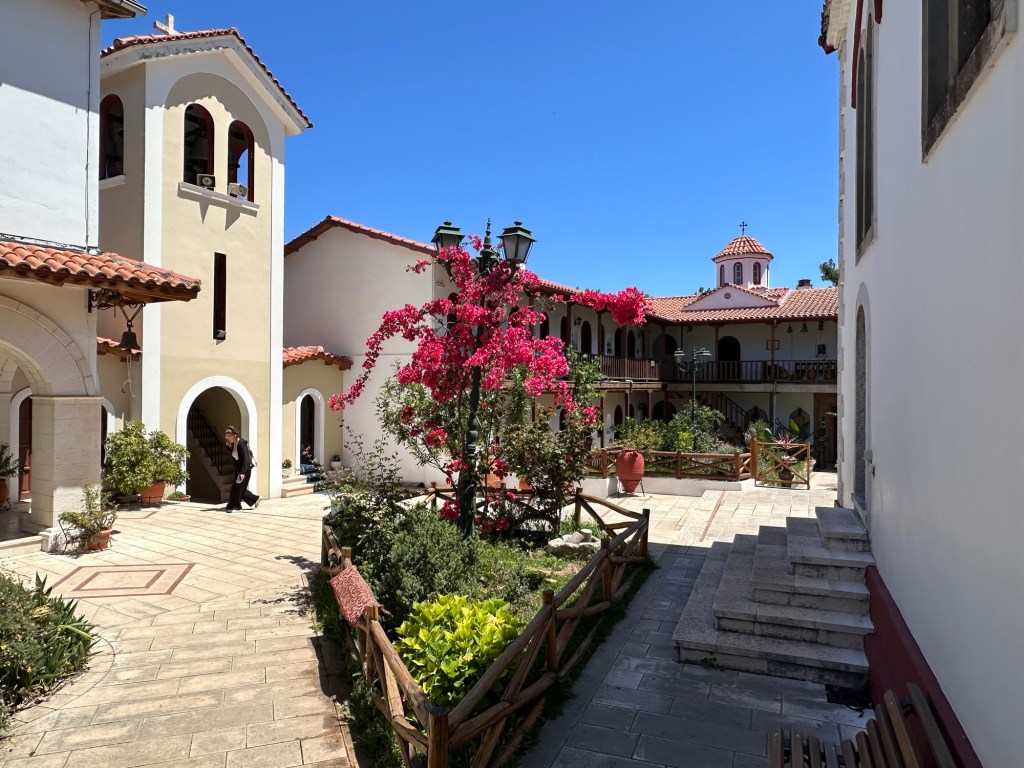
The island’s most important monastery stands on the wooded hill west of Lefkada Town, looking over the lagoon. By tradition it grew from the first Christian sanctuary on Lefkada, and two of the five Holy Fathers stayed here. In 1804 it was one of only two monasteries spared from closure. Today it is a working monastery with an ecclesiastical museum.
Walk: our Early Churches Walk follows the first Christians from Agios Ioannis beach, where tradition says they landed (the little rock church of Agios Ioannis Antzousi marks the spot), up to Faneromeni.
The Holy Fathers’ hermitage

A cave monastery on a ridge of Skaros, beside the road from Alexandros down to Nikiana. By Church tradition, three of the Holy Fathers who came back with Bishop Agatharchus from the Council of Nicaea in 325 made the cave their home and lived out their lives here in fasting and prayer. They are buried in the cave, where a spring of holy water still flows. In recent times it was a nunnery attached to St George’s; the last nun died in 1978. Pilgrims still come, above all on the Sunday of the Holy Fathers, the Sunday before Pentecost. The whole story of the Holy Fathers and the island’s first Christians is in Early Christianity on our History page.
Walk: a short detour, about 500 m, from our Skaros from Nikiana Loop. More on alexandros.online.
St George’s, Skaros

In the forest above Kolyvata, at the start of the old path up Skaros, St George’s was once one of the richest monasteries on Lefkada. It was founded or rebuilt in 1611, and may be older still. By 1727 it owned 708 acres of farmland and 900 sheep and goats, and kept an important library. The church inside its walls dates from 1700 and was enlarged in 1724, when its gilded wooden icons and wall paintings were made. In 1804 it was one of only two monasteries on the island left open.
For Alexandros and Kolyvata, St George’s was the main employer. Every Easter the monastery handed out the year’s work – looking after its goats and sheep, working its fields – in what were in effect annual contracts. When its land was taken in the expropriations of 1926–32, that work went too. It was part of the decline of Alexandros.
Its feast is St George’s Day, 23 April, moved to after Easter when Easter falls later. The monastery has now been fully restored after earthquake damage, and it opens for vespers one day a week through most of the year. At other times you can see much of it from the path.
Walks: the Kolyvata to Skaros Forest Loop, the Red Church – Skaros – Kolyvata Loop and Lefkada Trail Day 2 all pass right beside it. More on alexandros.online.
The Red Church (Evangelistria)

The Monastery of the Evangelistria (the Annunciation) at Platystoma, in the forest below Alexandros, is known to everyone as the Red Church – and was known to the Ottomans as Kizil Kilise, which means the same. Its Ottoman-era records are a rare window on island life. In 1626 its monks bought two fields in Alexandros from Yusuf, son of Mesih Reis, of the Agia Mavra fortress. In 1648 Pagona, daughter of the priest Giannis, gave it her vineyards at Fryni. In 1666 a monk of St George’s handed it two monasteries that had fallen into ruin. Locals call it Byzantine. Its feast day is the Annunciation, 25 March, which is also Greek Independence Day: the lawn in front fills with tables, music and dancing.

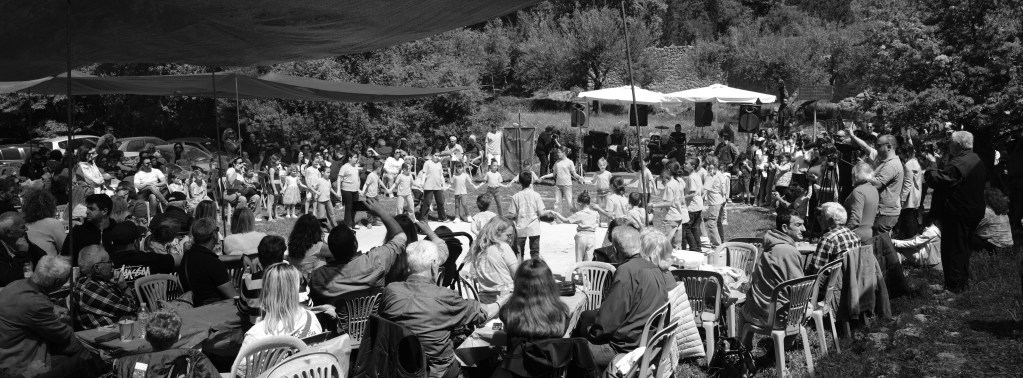
Walk: the start of the Red Church – Skaros – Kolyvata Loop.
Asomatos Michail, Vafkeri

A small, charming monastery of the Archangel Michael, also called Agii Asomati (the Bodiless Ones), in the forest below Vafkeri. It was one of the eighteen monasteries still working at the end of Ottoman rule, and towards the end of the 18th century it took over Agios Ioannis at Rodaki.
Walk: the Vafkeri Lower Loop from Nidri.
Agios Ioannis at Rodaki

On a hilltop clearing in the lush valley below Syvros, south of Vournikas, the monastery of St John the Theologian at Rodaki stands on the site of an ancient Doric country sanctuary, probably of Demeter, goddess of agriculture and fertility – a fitting home for her in this fertile valley. Doric capitals and part of the temple’s tiled floor survive, round column drums lie around the grounds, and its blocks are built into the walls and foundations of the church. The church was most likely built in 1654, and the monastery was one of the eighteen still working at the end of Ottoman rule. Towards the end of the 18th century it came under Asomatos at Vafkeri. Recently restored, it is in good condition and has regular services, under the parish priest of Vournikas; on its east wall are fragments of very finely painted frescoes. Its feast day is 8 May, and services are also held in Holy Week and on 15 August.
The old link with fertility lives on. Couples hoping for a child still come here to pray, and tradition says that if they hear footsteps outside while they pray, a baby is on the way. With its shade and quiet, it is also a lovely place for a picnic.
Walk: Syvros to an Ancient Temple and Agios Ioannis Monastery, a gentle walk of about 4.4 km from the village square, past the Kanali spring and down through the trees of the valley. The Antelikos Sivros Cultural Club marked the route and takes groups along it; their small museum is in the old schoolhouse where the walk begins.
Agios Ioannis on the Livadi
The monastery of St John the Baptist (Prodromos) stands on a gentle slope at the edge of the Livadi, the plain below Karya that floods in winter (see Geology). Founded in 1605, for three centuries it mattered to the whole island – spiritually, socially and economically. By the 18th century the Odigitria and many other churches around Lefkada had become its dependencies, and in the early 19th century it was the richest and most populous monastery on the island. It even funded a secondary school in Lefkada Town, run by the Enlightenment scholar Athanasios Psalidas. In the middle of the church lies the grave of the armatolos (armed rebel) Simos Bouas, known as Grivas, who died in 1622. The simple single-aisled church, with its wooden roof and women’s gallery, is painted with fine 18th-century murals in three bands: full-length saints at the bottom, saints in medallions above them, and at the top the 24 stanzas of the Akathist Hymn. The ruins of the monks’ cells and of a chapel of St Nicholas still stand around it. The monastery broke up in 1925 and its land was shared out among farmers, but the church has been rebuilt and is used again, under the parish priest of Karya; local schoolchildren come to learn about it. Its feast day is 24 June.
Walk: Lefkada Trail Day 2 crosses the Livadi on its way from Alexandros to Karya.
Agios Nikolaos at Ira
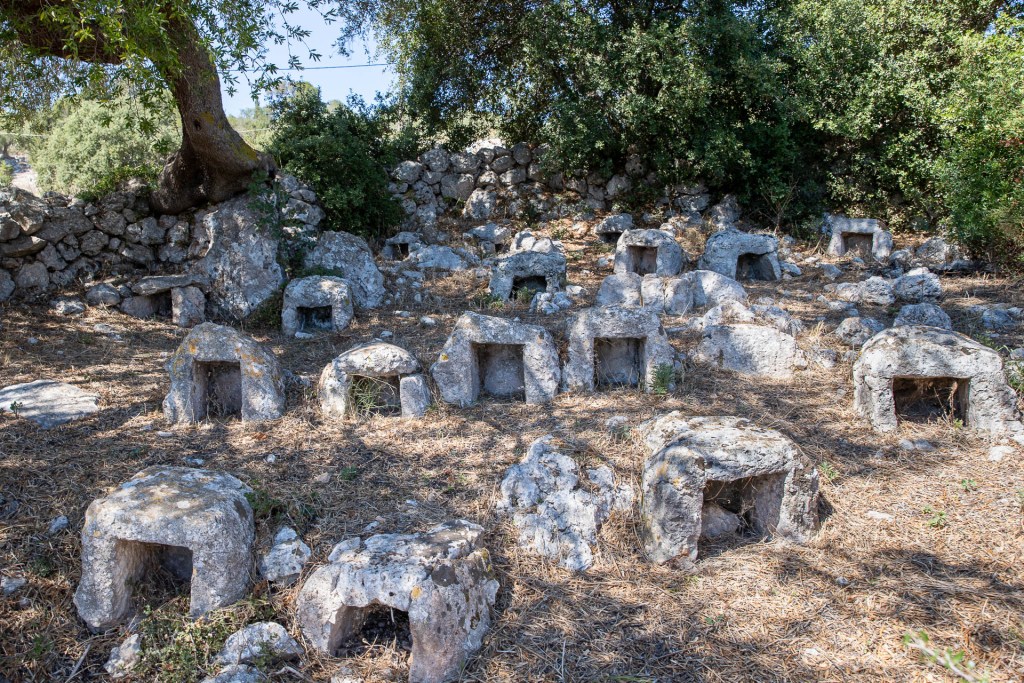
The monastery of St Nicholas at Ira, near Athani at the south-western end of the island, a few kilometres from Porto Katsiki and Cape Lefkatas, was built in the 17th century by families from Athani. For a long time it was run under a system of patronage, with the founding families choosing its abbot and priests, and it was also a place where clergy were sent into exile. It was one of the eighteen monasteries still working at the end of Ottoman rule, and it is one of the few still living as a monastery today: it is home to a community of nuns, under the parish priest of Athani. Its carved iconostasis, made by Andreas Betzos in 1799, has come down almost untouched, and it keeps an icon of St Nicholas painted in 1699. Its great day is 10 May, the feast of the bringing of St Nicholas’s relics from Myra to Bari, a holiday for the whole of the south of the island. Nearby are an old threshing floor and rows of 17th-century stone beehives, kept for the bees drawn by the wild thyme, and the nuns run a small shop. The nuns ask that no photographs are taken of the monastery itself or of them, so please put your camera away there, and respect their quiet and their dress code.
Walk: a short detour, about 500 m, from Lefkada Trail Day 6.
The other monasteries
These are not on our walks yet, but are worth seeking out.
Panagia Odigitria, Apolpena
One of the oldest religious buildings on Lefkada, on the northern foothills of the mountains south-west of Lefkada Town, reached by a narrow path from the Lefkada–Karya road. A monastery of this name is recorded in a Vatican manuscript of 1025. The present church was built in 1449/50, under the Tocco rulers, perhaps on an older one; its foundation inscription names the founders as Iakovos and Zampia. Under the Ottomans it may have served as a mosque. An Ottoman court record of 1666 shows it in ruins and handed to the Red Church, and from 1702 it was a dependency of Agios Ioannis on the Livadi. Its land was expropriated in 1927.
Earthquakes in the 1940s and 1950s badly damaged it. In the 1960s it was given a new roof and its plaster was stripped, uncovering its frescoes, and in 1968 most of them were taken down and moved to the Byzantine and Christian Museum in Athens. After further repairs following the 2003 and 2015 earthquakes, the church is now coming back to life: the iconostasis has just been put back, and this autumn the Ephorate of Antiquities is returning fourteen fresco panels to the south and east walls, among them the Transfiguration, the Nativity, the Last Supper and the Apostles at Pentecost. The panels are fixed on new supports so that the work can be undone without harming them. The church and its surroundings are a listed monument.
Agios Nikolaos, Nikoli
The ruins of a cross-shaped, probably domed church of the 10th century, with brick-banded walls in the style of Constantinople and a rounded apse. It stood on a main route with land around it. It has recently been restored and rededicated.
And more
- Panagia Dematisana, on the Gyra north of Lefkada Town – a Patriarchal and Stavropegic monastery, answering directly to the Patriarch in Constantinople.
- Panagia tis Episkopis (the Nativity of the Virgin), Spanochori – seat of the island’s archbishop until 1689.
- Profitis Ilias, Spanochori – reached by an old cobbled path from the village.
- Agios Nikolaos at Thermata, Eglouvi.
- Agios Dimitrios at Grava, Charadiatika.
- Agios Georgios at Pisa, Marantochori – a restored church with a white bell tower beside the ruins of the old monastery buildings.
- Agios Kirykos, Athani.
- Taxiarchis Michail at Adani, Platystoma, near the Red Church.
- Agios Ioannis Prodromos, Spartochori, on Meganisi.
- Smaller monasteries and dependencies: the Pantokrator at Kavalos, the Panagia at Kipi near Kalamitsi, Agia Thekla at Perigiali, the Analipsi at Fryni, Agios Georgios at Vatia near Neochori, Agios Ioannis at Perivolakia near Syvros, and in Lefkada Town Agios Vissarion and Agios Dimitrios, which belonged to St George’s and the Red Church.
We will add more of these to our walks as we explore them. If you know a monastery we have missed, or its story, tell us in our Facebook group.
Sources
- Archimandrite Ioannikios Zambelis, Τα μοναστήρια της Λευκάδας: Αναδίφηση στην Ιστορία – Ενατένιση στο μέλλον τους (The monasteries of Lefkada: their history and their future), talk at the 5th Meeting of Alexandros, Society of Friends of Alexandros “Figos”, 29 June 2014. Includes translations of Ottoman court records of 1626, 1648, 1666 and 1716.
- K. G. Machairas, Ναοί και Μοναί Λευκάδος (Churches and Monasteries of Lefkada), Athens 1957.
- Lefkada – Religious Destinations, visitor guide (entries for St Nicholas at Ira, St John Prodromos on the Livadi and St John Theologos at Rodaki).
- St George’s Monastery and Holy Fathers Monastery, alexandros.online.
- The Holy Fathers in Church tradition: Saint Agatharchos, Bishop of Lefkada, and the Holy Fathers, after the hagiology of the Metropolis of Lefkada (2015).
- The temple of Demeter at Rodaki: see our walk page.
- The Odigitria and the return of its frescoes (in Greek): Ι.Ν. Οδηγήτριας Απόλπαινας: Έχει υπογραφεί η σύμβαση για την επανατοποθέτηση των αποτοιχισμένων τοιχογραφιών, Lefkaditika Nea via kolivas.de, 30 October 2026; and Ministry of Culture decision, kolivas.de, 14 October 2026.